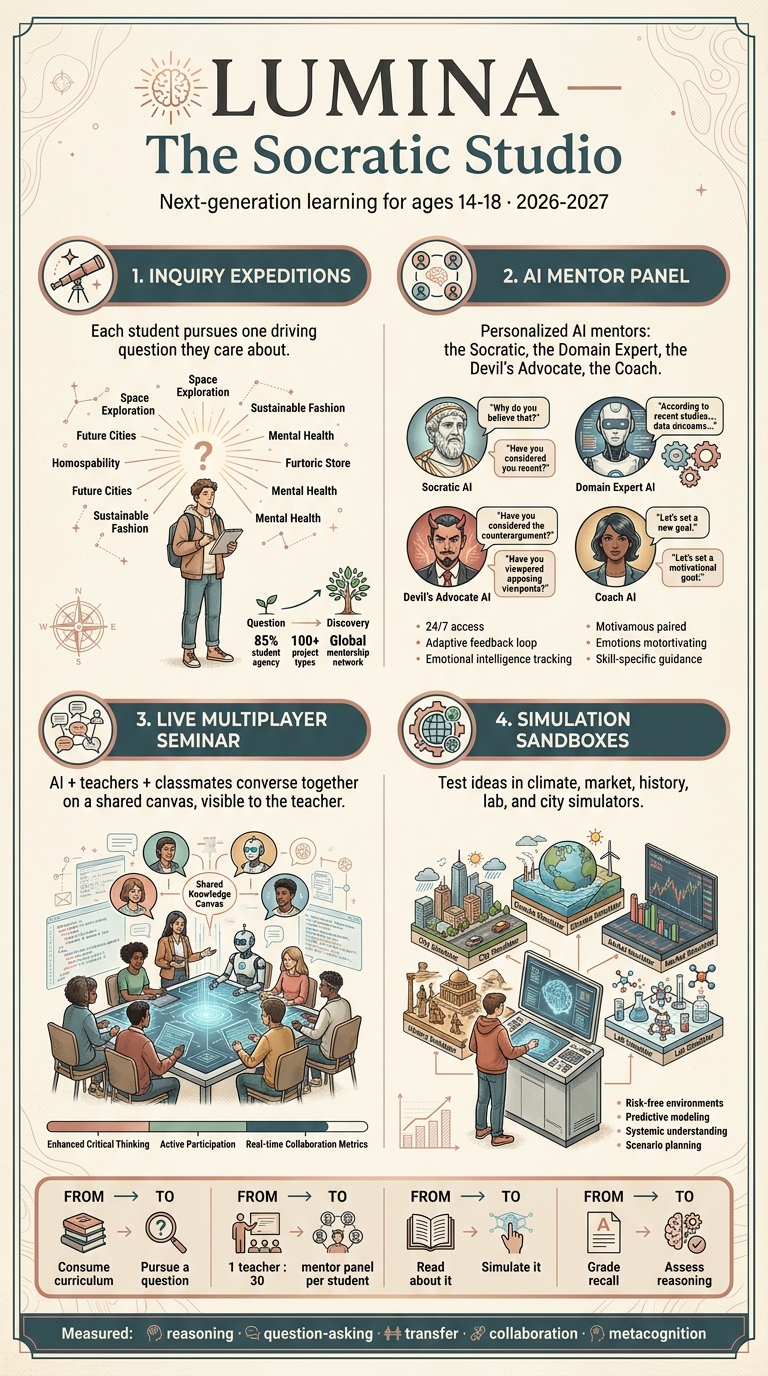
From consuming a curriculum
to pursuing a question
Four pillars
1 · Inquiry Expeditions
Each student commits to a driving question they actually care about — the term orbits it.
2 · AI Mentor Panel
A personalized team of AI minds with distinct epistemic roles and memory of your journey.
3 · Live Multiplayer Seminar
AI converses in the same room as teachers and classmates — visible, never a hidden tab.
4 · Simulation Sandboxes
Test ideas in climate, market, history, lab and city simulators — learning by doing.
Inquiry Expeditions
"Should my town build a seawall?" · "Can a city be fed on vertical farms?" · "Was the printing press more disruptive than AI?"
The student is the principal investigator. Research, simulation, conversation, and output all serve their question — for a whole term.
The AI Mentor Panel
Not one chatbot — a panel the student assembles, tunes, and converses with.
The Socratic
Never gives answers — only sharper questions. Rate-limited from solving it for you.
The Domain Expert
A tunable persona: marine biologist, Roman senator, startup CFO.
The Devil's Advocate
Attacks your thesis to harden it before the world does.
The Coach
Tracks habits, motivation, and metacognition over time.
Live Multiplayer Seminar
AI is a participant in the room, not a private tab. Students @-ask their mentors on a shared canvas; classmates jump in; the teacher sees the reasoning trail and intervenes.
AI visible to the teacher — by design
Maya & the seawall
Morning: she runs the flood simulator. Her Domain-Expert mentor flags a feedback loop she missed. She @-pulls the Devil's Advocate into the seminar — it argues managed retreat is cheaper. Theo jumps in with budget numbers. The teacher pauses the room for a 6-minute Socratic huddle.
Friday: she defends a position paper
The capabilities just arrived
- Models can now hold a domain persona with memory — and assess reasoning, not just grade answers.
- Real-time multi-party AI on shared canvases is newly viable.
- Sims + LLM narration make learning-by-doing scalable to every classroom, not just elite labs.
- Putting AI in the open seminar flips the cheating risk into a thinking-partner upside.
Guardrails
Transparency by default
Every AI exchange is visible to the teacher — no hidden homework-bot.
Productive struggle
The Socratic mentor must escalate questions, not hand over answers.
Provenance
Work logs which ideas came from AI, peers, or self — teaching intellectual honesty.
Human-in-the-loop
AI proposes, the teacher disposes. Grades are never fully automated.
The model on one page